How I Communicate
How I Communicate is a research project exploring the communication of minimally and non-speaking autistic people. We take a strengths-based approach and support multi-modal forms of communication. We do not automatically equate non-speaking with learning difficulties, nor do we assume that communication difficulties reside only with the person deemed to have ‘impairments’. We also recognise that many minimally and non-speaking people lack support, as well as opportunities to develop their communication skills, and can be denied agency. This project has been funded by the ESRC and the John and Lorna Wing Foundation.
Our Research
The focus of our research is autistic young people, aged approximately 12 – 25, who are minimally or non-speaking and may be in education settings in the UK.
As part of this study, we have conducted a systematic review of the number of autistic people in the UK who are minimally or non-speaking – the results will be published in due course.
We have also conducted interviews and focus groups with parents of autistic young people and with speech and language therapists. These findings are currently being developed for a publication in an academic journal, and we will also be writing an accessible version.
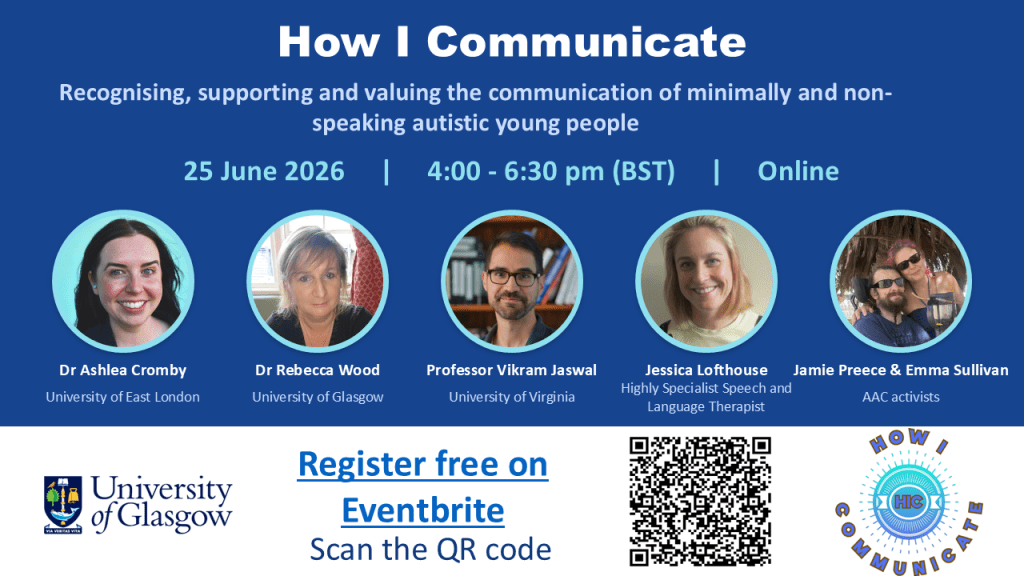
HIC event: 25th June 2026
Sign up for an evening of presentations and more to be held on 25th June 2026 at the University of Glasgow. The event will include an interactive exploration of an exhibition of internet memes by Dr Ashlea Cromby and talks from different speakers on multimodal communication. The keynote speaker is Professor Vikram Jaswal from the University of Virginia in the US. Information on how to sign up is below👇
Publications
A previous iteration of the project included a conference on the theme of multimodal communication. You can read about this event in The Psychologist, the magazine of The British Psychological Society. Rebecca Wood was also invited to write a review of the film The Reason I Jump, based on the book by non-speaking Japanese author Naoki Higashida, which explores the experiences of non-speaking autistic young people in different countries. You can read the article here.
Rebecca’s book chapter From Disempowerment to Well-being and Flow: Enabling Autistic Communication in Schools was published in The Routledge International Handbook of Critical Autism Studies, edited by Professor Sara Ryan and Dr Damian Milton.
Drawing on findings from her PhD, Rebecca published an article in the Educational Review about the communication of the autistic children in five primary schools in England. The article can be found here although it is not open access. The full text of the author’s accepted version can be found here.
Rebecca was commissioned by the Therapist Neurodiversity Collective to produce some training materials on autism and communication in 2022.
Rebecca was invited to speak at the Interdisciplinary Autism Research Festival in 2021. The title of her talk was The Silencing and Marginalisation of Non-speaking Autistic People. The video can be viewed here.
Rebecca drew on her interest in both The Archers (a radio drama on Radio 4 that has been running for 75 years) and non-verbal communication by writing about the power of the silent characters in the drama. She spoke about the link between her research and silent communication in The Archers at the Academic Archers conference, held in the British Library in 2018, and later published a book chapter Foucault, Freda Fry and the Power of Silent Characters on the Radio in Gender, Sex and Gossip in Ambridge: Women in the Archers, edited by Dr Cara Courage and Dr Nicola Headlam. This chapter has resonated with journalists, and has been referenced in The Guardian and The Economist.
Elaine McGreevy is a neurodivergent speech and language therapist, author, speaker, consultant, and trainer with over 30 years of experience supporting autistic children, young people, and their families. She has worked extensively within NHS Autism and Child Development Services, including autism diagnostic and support pathways, and now works in independent practice.
Publications from Elaine:
McGreevy, E., Quinn, A., Law, R., Botha, M., Evans, M., Rose, K., Moyse, R., Boyens, T., Matejko, M., & Pavlopoulou, G. (2024). An experience sensitive approach to care with and for autistic children and young people in clinical services. Journal of Humanistic Psychology, 66(1), 108–145. https://doi.org/10.1177/00221678241232442
McGreevy, E. (2025). Embedding a humanising compassionate pedagogy for collaborative learning in the neurodiverse classroom. In K. Davis, S. O’Neill, & E. Fletcher-Watson (Eds.), It takes all kinds of minds: Fostering neurodivergent thriving at school. Routledge.
Nair, V. K. K., & McGreevy, E. (in press). A critical analysis and reframing of social communication in autism and social communication disorder. In Y. Ortega, M. R. Brea, S. Canagarajah, & N. Walker (Eds.), The Routledge handbook of neurodiversity and applied linguistics. Routledge.
Contact
Dr Rebecca Wood at the University of Glasgow: Rebecca.Wood@glasgow.ac.uk
 howicommunicate.com